Stories & Soliloquies

Stories & Soliloquies
    • Tag: christmas

      • The Magic of Santa Claus

        Posted at 3:00 pm by michellejoelle, on December 24, 2013

        In some ways, I never believed in Santa Claus. In other ways, I still think he’s as real.

        I figured out pretty early that it was impossible for Santa Claus, as a physical human being, to do all the things he was supposed to be able to do. I crafted every version of magical theory I could to try and make sense of it all, but I couldn’t come up with anything internally consistent enough to be satisfying. My parents agreed, and so the story in my house was that Santa used to be a real person who gave out presents, and parents then carried on the tradition in his name.

        Nothing was ruined for me. I had just as much fun imagining historical Santa Claus as I did magical Santa Claus, and I loved playing the game – I wrote letters knowing they would go to my parents, and I left them cookies too. I pretended I heard reindeer on the roof, and listened for my dad to shake the jingle bells I knew he had by his bedside. I was in on the joke, but it still worked for me. And I think, actually, that it still does. As an idea, Santa Claus carries more weight (no pun intended), depth, joy, and truth than he ever could as a “real” person bound to the particularities of lived experience.

        What it comes down to, really, is that Santa is magic, in the same way that linguistic concepts are inherently magic. Words are magic spells cast on our minds, calling up all sorts of ideas and connections and connotations without us having to move a mental muscle, allowing you to participate in an idea that goes far beyond any quantifiable or physical referent. Rousseau expresses this most clearly when he explains, in his Discourse on the Origin of Inequality, that concepts can only really exist in your mind as words or phrases. The reality of thought is purely linguistic:

        If you endeavour to trace in your mind the image of a tree in general, you never attain to your end. In spite of all you can do, you will have to see it as great or little, bare or leafy, light or dark, and were you capable of seeing nothing in it but what is common to all trees, it would no longer be like a tree at all.

        While this leads Rousseau to disdain the overtly philosophical for its total remove of the referent, I think there’s something more positive – something beautiful – at work here. The turn to the ideal concept is a turn to knowledge that goes beyond the limitations of your immediate surroundings, and lets you participate in something larger.

        To grab onto a general idea like “tree” lets you use that signifier to speak to anyone who also has that idea, whether the trees that are real for you have ever been real for your discussion partner. The physical, quantifiable things are only real for those who see it, while they are able to see it. Ideas marked by words and phrases can be real for everyone, everywhere, for all time – even if the linguistic marker shifts, it is still part of a larger network, wherein eventually, the word and the idea it represents meld together indecipherably, granting the power of the idea to the word by which it is signified.

        Says St. Augustine, in his dialogue De Magistro (The Teacher):

        To handle words with words is to interweave them like interlaced fingers: rubbing them together makes it hard to tell, except by each finger on its own, which is doing the itching and which the scratching.

        In this way, words pull you subconsciously into a network of knowledge and community and history without you ever having to think like a philologist. I think that images can do much the same thing, and have real power over the way we think and see the world. As ideas need not have a physical presence in order to be real, neither, I think do characters and stories. And so I believe in Santa Claus, because I believe in everything he represents – imagination, joy, giving, tradition, magic – and because I believe in images that let us hold so many ideas together in our minds at once without us having to break them down into disparate parts.

        And in this way the idea of Santa can become more real than just a collection of ideas held together under a jolly umbrella – it creates something new, something that can exist apart from the particularities of its inception and take a life of its own.

        That’s the reason I believe in ideas, in stories, in magic, and even in Santa Claus.

        Related articles
        • Why I believe in Santa Claus (chrismarkham.wordpress.com)
        • Why I still believe in Santa Claus (buncheslife.wordpress.com)
        • The Wonders and Physics of Santa Claus [Infographic] (infotainmentnews.net)
        Posted in Essays | 5 Comments | Tagged christmas, harry potter, language, Metaphysics, stories, words, writing
      • The Ephemerality of Gingerbread Houses

        Posted at 10:00 am by michellejoelle, on December 16, 2013

        One of the things I love about stories – particularly myths – is that they can grow inside your mind. They’re expansive and engulfing, leaping off the page and turning into something full and exciting as you put them into your mind. Writing lets me take that experience and leave behind a record can reawaken that story if ever it goes dormant.

        But there are lots of experiences for which this isn’t so easy. You can’t really capture the experience of a live performance in a recording. You’ll watch it later or look at photos and it won’t be the same. You can remember the ephemeral experience of a particular dance, the delivery of a line, or a moment of harmonization, but you’ll be grasping after a fading image, elated for a while, but eventually, mourning its loss. It’s not impossible to keep a hold on it, but it’s harder.

        These experiences can be hyperbolic and transcendent precisely because they are so brief. Like the flash of colorful foliage that makes autumn so delightful, like sandcastles doomed to wash out to sea, and like dancing to a live band, these experiences burn a little brighter for their ephemerality. They demand that your full attention be given the moment, because there’s no coming back to it another time. Feel this now, they whisper, holding your mind as you try desperately to take in as much of the moment you can.

        96467443-5C90-4C3F-BA3F-4D49223D0F602011

        EEA8AA2D-0D5F-47AB-A4D9-473861435253

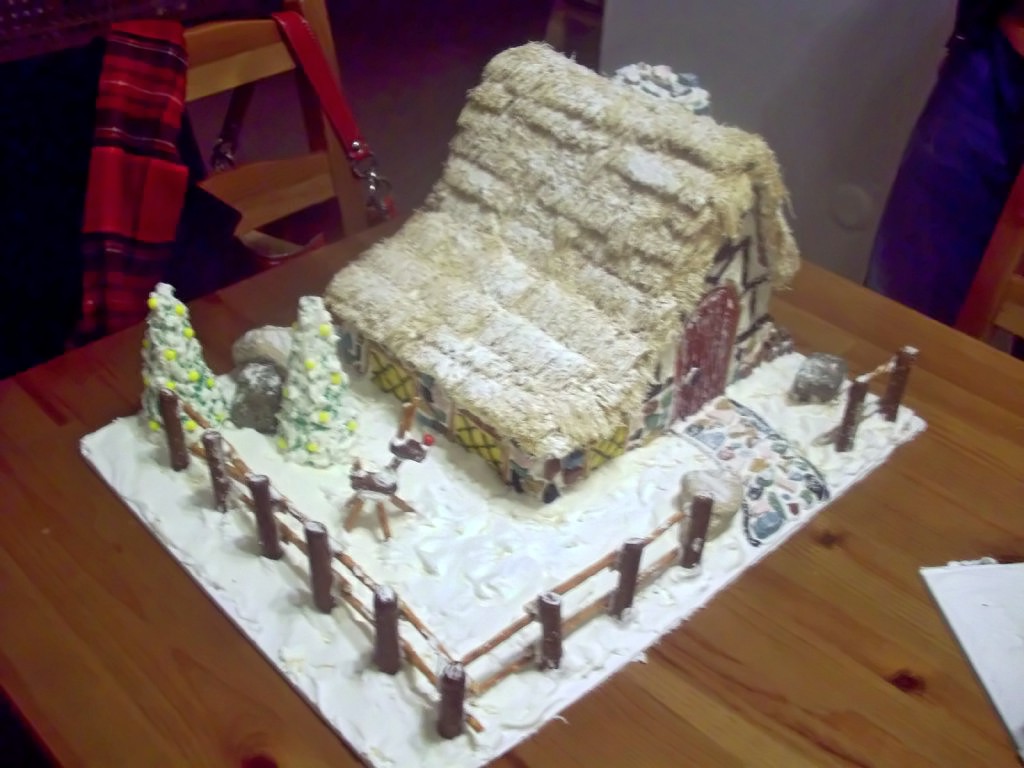
        The past two years, my husband and I have made Gingerbread houses for the Christmas season. The first year, we spent hours of time over the course of several days over the course of two weeks designing, baking, shopping, decorating, constructing, and landscaping. There were long sessions of doing geometry, most of which was abandoned when we realized that gingerbread doesn’t bake to precision, visits and revisits to multiple candy stores, and moments of agony when the pretzel reindeer I’d been holding for an hour while it dried crashed to the floor and I had to start over.

        And then, after just a month or so of enjoying this incredible labor of love, we dumped it in the trash. Gingerbread houses don’t last forever, and it’s devastating to see them go. All that careful construction, the hours of placing individual strands of shredded wheat to fill out the thatched roof, the starburst masonry, all gone in an instant of post-holiday cleaning.

        7c595d5e_o2012

        31584_3411283940033_593798263_n

        It was worth every minute. The limitations of the material are freeing because the constraints force me to be more creative as I make it, and more unrestrained in my experience of it.

        I think this is the case for all ephemeral arts. They don’t just shine brighter because they’re about to flame out, they shine brighter because we see them more generously. We have to. If we don’t drop our filters and open ourselves wholly to them, they won’t take hold of us, and we’ll miss them when they fade.

        This includes snowmen, too.

        IMG_5204

        IMG_5234

        They really don’t last. 🙂

        IMG_5460

        Related articles
        • These museums are actually unbelievable gingerbread houses (jeremiahtillman.wordpress.com)
        • Itsy Bitsy Gingerbread Houses (bourbonlavender.wordpress.com)
        Posted in Essays | 9 Comments | Tagged christmas, crafts, ephemerality, gingerbread houses, stories
      • Lights in the Darkness

        Posted at 10:00 am by michellejoelle, on December 2, 2013

        With advent upon us, I thought I’d start December out with some words on light and hope in the face of darkness and fear. The nights are coming more quickly, and the dark is lingering on, but everywhere, people put out candles and fairy-lights to make the most of the darkest time of the year. The more darkness there is, the easier it is to see the lights, and the more powerful and beautiful the lights are. Its enough to make some choose this – the darkest time of the year – as their favorite time of the year.

        In the face of sadness, fear, doubt, and powerlessness, maybe it’s enough to look on the bright side.

        downsized_1222111412

        In his post, “Hope and Fear“, Christian Mihai points to hope as weapon against the darkness.  It’s not some substantive thing that heads it off, but the mere anticipation that something will – or at least, that something could.

        But at the same time hope is there as well. And we never, ever lose hope. Yes, at times we might lose hope in our own strengths, or our passions, but we never lose hope that something’s going to happen. Even at the edge of the dark abyss, we still hope that someone’s going to save us – we need a hero to save us from the hopelessness of staring into the abyss for too long.

        The amazing thing about hope is that nothing actually needs to happen, and it still works. In fact, any single thing that does happen will fall short in comparison to the hope for what could, not just in potential, but in actual power. It’s why we tell stories of improbable triumphs, celebrate holidays and special occasions, and sing songs. We light tiny lights to bear down the inimitable darkness and make it something wonderful.

        Even in her more pragmatic take on finding happiness, Nimue Brown seems to focus on situations and people with high standards, and on knowing what to do to keep things going, even when it may be difficult. It seems to be less about the resting point than the continuing trajectory, even if it isn’t always nice.

        I can be really happy working for a focused tyrant who has a really important vision and demands the nigh on impossible of me. I like the challenge, the sense of purpose, and the things that can be achieved.

        Even though it feels counter-intuitive, there’s happiness to be found in the most demanding situations – because there’s something to shoot for. The “things that can be achieved” are listed as equal to “the challenge” and “the sense of purpose” – not above them.

        In Book XIX of The City of God, Augustine implies that hope is not just anticipation of the good that you wish to come, it is the reflection from the goodness beyond, reaching back to us in order to pull us along. He goes on at length about the various ways that even good things can disappoint us, because the evil in the world is so insurmountable tat happiness seems impossible. But he doesn’t just give up. As long as we keep our heads up and our eyes fixed on the far away light of God, even though we cannot see it directly but can only use it as a guide for where to look, the overwhelming darkness around us can’t swallow us whole. As soon as we drop our gaze and trying to grapple with the misery on our own terms, we get pulled into it.

        Christian metaphysics aside, its tempting to think that even though the ills of the world – the sadness, the fear, the powerlessness – threaten to overcome with infinite vastness, if I keep hope, I’ll somehow be connected to something good, even if it is presently out of my reach. It’s a different vision of happiness than most people typically covet. It’s not always joyful or easy, but can be arduous and frustrating.

        But it’s also weirdly freeing – in placing happiness in hope, Augustine removes from it the contingency of a model where happiness is found in some object, act, or even a person, so that even if I fail, or if circumstances fail me, I could still be happy, and still find a way to help others be happy where I can, even if my contributions are miniscule. It’s a vision of happiness that keeps me writing, even when I feel like I’ll never finish my story, that keeps me trying to fix things when I make mistakes, or when things fall apart, or when I just want to give up.

        I’d like to think what Augustine says is true, and that the little lights of advent candles are more than just a way to find illusory comfort in the darkness. Let’s just say – I can hope.

        Posted in Essays | 1 Comment | Tagged Augustine, christmas, darkness, lights
      • Recent Posts

        • A Fairy Tale Feast, Part 3: Forager’s Pie
        • A Fairy Tale Feast, Part 2: Simple Breakfast Hash
        • A Fairy Tale Feast, Part 1: Apple, Cheddar, Beer and Potato Soup
        • In My Pensieve: A Link Round Up
        • The Magic of Santa Claus
      • Categories

        • Essays (11)
        • The Waste Book (9)
        • Poems (2)
        • Series (2)

    Blog at WordPress.com.

    Privacy & Cookies: This site uses cookies. By continuing to use this website, you agree to their use.
    To find out more, including how to control cookies, see here: Cookie Policy
    • Subscribe Subscribed
      • Stories & Soliloquies
      • Join 420 other subscribers
      • Already have a WordPress.com account? Log in now.
      • Stories & Soliloquies
      • Subscribe Subscribed
      • Sign up
      • Log in
      • Report this content
      • View site in Reader
      • Manage subscriptions
      • Collapse this bar
     

    Loading Comments...
     

    You must be logged in to post a comment.